Showing posts with label Linda Lea Theatre. Show all posts

Thursday, June 25, 2026

"L.A.X."

A "Closed For Restoration" shot of the Vista Theatre from Fabrice Ziolkowski's "L.A.X." (1980), dubbed "A hypnotic city symphony of bygone LA." Los Angeles Filmforum and the Philosophical Research Society in Los Feliz are hosting a July 17 screening of the 90 minute film as part of the PRS "Yesterday LA2026" series. Tickets are on Eventbrite.

See the pages about the Vista Theatre on the Los Angeles Theatres site. As noted on the marquee it was to reopen August 1. It originally opened in 1923 as Bard's Hollywood Theatre.  

There's a listing for the film on the Fabrice Ziolkowski website. The description:

"Avant-garde documentary / 16mm black-and-white / 90 min. — written and directed by Fabrice Ziolkowski. An experimental film essay on Los Angeles as a landscape of movement, exile, infrastructure and disappearance. Screened in museum and festival contexts, including the Reina Sofía in Madrid and the Art Institute of Chicago, and discussed by film historian David E. James in 'The Most Typical Avant-Garde.'"  

Also see the site's "L.A.X." stills page. 
 
Thanks to Chris Nichols, a senior editor at Los Angeles Magazine, for spotting a 7th House Instagram post about the July 17 event and grabbing the shot of the Vista. The latest book by Chris, with Adriene Biondo, is the Angel City Press release "Bowlarama: The Architecture of Mid-Century Bowling." 
 

A look west across Main St. toward the Linda Lea Theatre, 251 S. Main. It began life in 1925 as the Arrow and was decades later rebuilt as the ImaginAsian, later renamed the Downtown Independent and then called The Kult.  
 

The film's view of the back of the Rialto Theatre, 812 S. Broadway. The signage pointing to the "Newsreel Theatre 8th & BDWY" is directing us to the Tower Theatre. It was called the Newsreel from 1950 until 1965.  
 

The April 1979 release "Boulevard Nights" playing with "The Swarm." See the pages about the Orpheum Theatre on the Los Angeles Theatres site.  It's at 842 S. Broadway. 
 

There's five minutes of footage from the film on Vimeo featuring a long shot of the north side of 5th St. We get a quick look up Hill St. toward the oval Pussycat Theatre signage and then go by the Philharmonic Auditorium. See the pages about the Pussycat/Town Theatre and the Philharmonic Auditorium on the Los Angeles Theatres site. 

There were notes about "L.A.X." on Eventbrite with the listing for the July 17, 2026 screening at the Philosophical Research Society:  

 "A rare screening of a landmark of Los Angeles avant garde cinema, a hypnotically drifting afternoon-to-evening cruise through a bygone LA... and a profound influence on subsequent works ranging from Pat O'Neill's brilliant 'Water and Power' to Thom Andersen's beloved 'Los Angeles Plays Itself.' Returning to Los Angeles screens for the first time in a decade, this seldom-seen work stands today as both an exquisite portrait of Los Angeles in 1980 and an inadvertent future artifact: a patient, immersive record of a city that has continued to erase, reinvent, and transform itself in the years since.

"A true city film and a singular avant-garde entry in the city symphony tradition—from Walter Ruttmann's 'Berlin: Symphony of a Great City' and Dziga Vertov's 'Man with a Movie Camera' to Chantal Akerman's 'News from Home' and Wim Wenders' 'Tokyo-Ga' —L.A.X. follows Los Angeles by car and on foot through long, hypnotic tracking shots and patient observations of its streets, landmarks, and overlooked corners. Created by French-American filmmaker Fabrice Ziolkowski, whose perspective seems suspended between Europe's deeper sense of historical continuity and America's restless appetite for reinvention, 'L.A.X.' brings to Los Angeles an outsider's eye akin to that of cinematic visitors like Agnès Varda, Jacques Demy, Wim Wenders, and John Boorman, rendering even its most familiar landscapes strange, improbable, and newly visible.

"Progressing from sweeping aerial vistas bathed in Southern California's stark, sun-bleached daylight to the seamier nocturnal realities of street-level Hollywood, L.A.X. traces a gradual descent from sunlit mythology into the noir realities and hidden histories that lie beneath. Accompanied by a richly layered soundtrack of ambient sounds, historical and literary texts, and songs ranging from Canned Heat to Robert Johnson, the film reveals a metropolis haunted as much by what is absent as by what remains—its displaced communities, vanished landscapes, and forgotten histories lingering just beyond the edges of the frame.

"The years have transformed what was once a portrait of the contemporary city into a kind of time-traveling road movie and urban séance, conjuring the vanished landscapes and past-lived realities of Los Angeles and inviting viewers to spend an evening drifting through them.

"FABRICE ZIOLKOWSKI is a French-American writer, screenwriter, filmmaker, translator and photographer. His work has moved across film, television, animation, documentary, translation, criticism and photography, often returning to figures and places at the edge of official narratives: workers, musicians, exiles, prisoners, vanished communities and myth-haunted landscapes. He wrote the screenplay for the Oscar-nominated animated feature 'The Secret of Kells' and is currently developing several literary projects, including 'The 12 Labors of Nathan Kowak,' a darkly comic American novel-in-stories."

On IMDb: "L.A.X."

Wednesday, March 13, 2019

"The Crow: City of Angels"


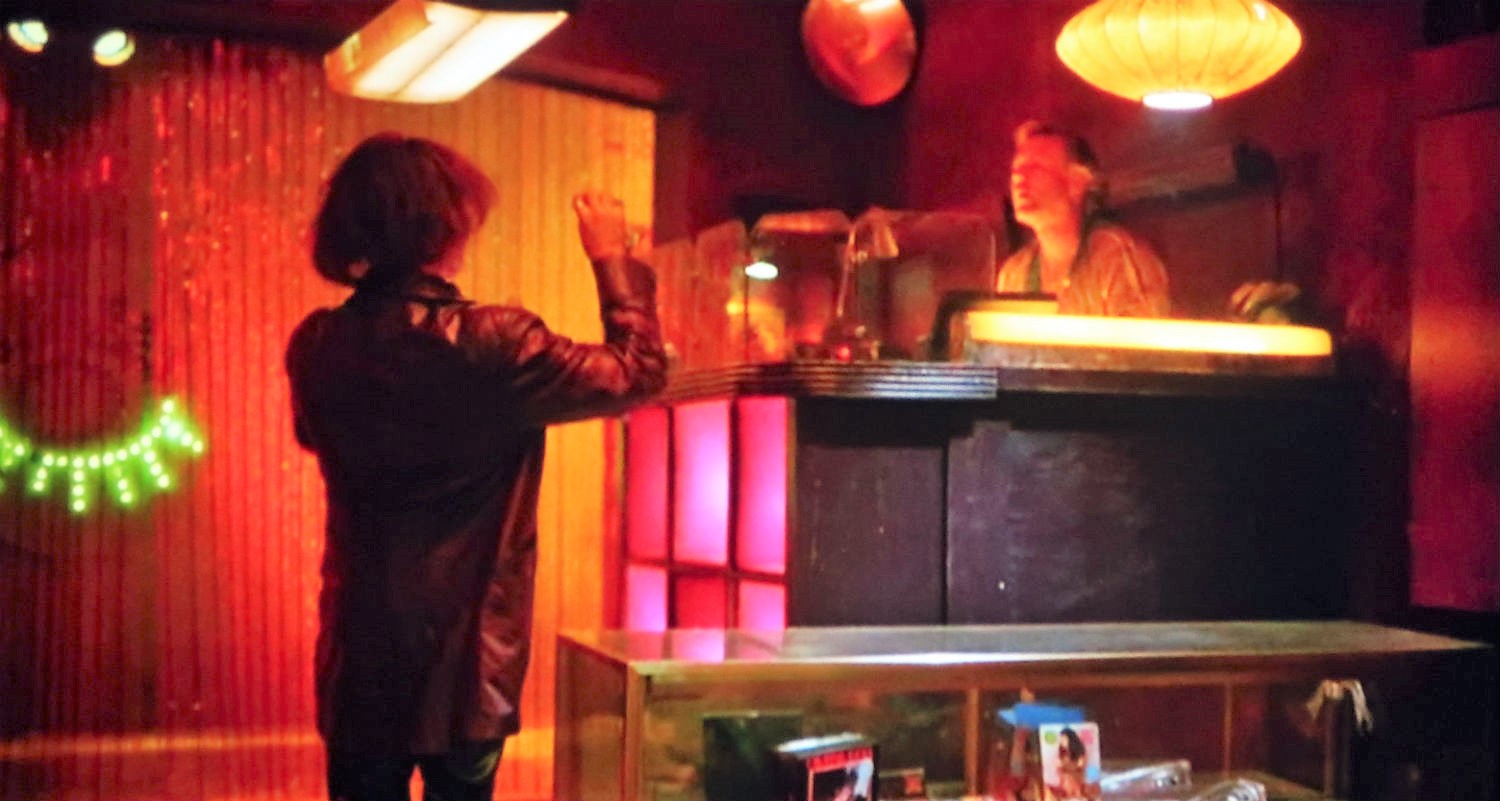
We pay a nice visit to the Linda Lea Theatre, 251 S. Main St., in the film "The Crow: City of Angels" (Dimension Films, 1996) starring Vincent Perez, Mia Kirshner, Richard Brooks and Iggy Pop. Tim Pope directed. The theatre had been closed for a few years at that point and was being used for storage.


Vincent Perez is back from the dead via the power of his totem animal, the crow. He's looking for the guys that killed him and his son years earlier. The Linda Lea is an early stop on the hunt as he's heard one of the bad guys is in there.


The theatre is dressed up as a venue with coin-in-slot booths to watch naked girls. We only get views of the lobby. When we go into where the auditorium should be it's a set of corridors and booths.


Perez finds the guy he's looking for and a fight in the lobby ensues.


A view toward the front doors.


A look into the lobby as a colleague comes to check on his buddy only to find him dead.

Only a couple walls and the roof structure of the Linda Lea were retained when the site was rebuilt as the Downtown Independent. See the Los Angeles Theatres page about the Linda Lea/Downtown Independent for more details about the theatres.


Part of the hunt for the killers includes a couple quick shots in the alley north of the Los Angeles Theatre. Here we're coming out of a side exit of the theatre. Note the signage. See the pages about the Los Angeles Theatre for a history of the 1931 vintage movie palace.


The lair of the bad guy of the film is in the lit tower of the United Artists Theatre. Here it's seen in a view from a model of the city the film uses for many shots, especially those showing the crow flying.


A closer view of the tower, again using a model. 


A shot in a set intended to resemble the tower's interior.


Another view of the tower set. 


A Day of the Dead revel in front of the real United Artists building.  


Looking to the top. Perez is going to climb the exterior to get to the man responsible for his death, played by Richard Brooks.


The climb begins.


Getting acquainted with some of the Gothic statuary.


Getting near the top.


Perez falls. He's lost his power when his totem animal is trapped and killed. But he's not dead -- only mortal rather than suffused with extraordinary powers. We next get a fight scene on the ground, mostly with shots done on a backlot set that includes another theatre exterior. 

See the pages about the United Artists Theatre on the Los Angeles Theatres site for many photos of all areas of the building. It's now known as the Theatre at Ace Hotel. See the roof page for views of the tower areas replicated in the sets used for the film.

On IMDb: "The Crow: City of Angels"

Tuesday, May 31, 2016

"Black Belt Jones"


About 50 minutes into "Black Belt Jones" (Warner Bros., 1974) we go for a drive on Main St. so Gloria Hendry can kick some sense into some henchmen of an associate of her late father. Here we see the marquee of the Follies Theatre, 337 S. Main St., on the left. The Linda Lea Theatre, 251 S. Main, is in the distance. Jim Kelly stars as the title character in this Blaxploitation saga directed by Robert Clouse.


Both before and after the shot with the Follies, we get variations on this view out the back window looking south along the east side of the 400 block. In the fuzzy distance just to the right of the mirror it's the marquee of the Regent Theatre, 448 S. Main St.


After our strange routing we arrive at our destination on the 400 block. We're looking south. She's headed for a pool hall in the basement of the San Fernando Building on the southeast corner of 4th and Main.

See the Los Angeles Theatres pages about the Follies Theatre, the Linda Lea/Downtown Independent, and Regent Theatre for more details about these Main St. showplaces.

On IMDb: "Black Belt Jones"