Showing posts with label Hollywood Theatre. Show all posts

Saturday, November 15, 2025

"Farewell, My Lovely"

The credit sequence of "Farewell, My Lovely" (Avco Embassy, 1975) features stylized footage of Hollywood landmarks. Here, just before the title appears, we're at the Earl Carroll Theatre, 6230 Sunset Blvd., just east of Vine St. The neon sculpture is of Beryl Wallace, Earl's girlfriend and a star of his shows. Thanks to Wayne King for noting the film's use of this footage. See the pages about the Earl Carroll Theatre on the Los Angeles Theatres site. 

The film is an adaption of Raymond Chandler's 1940 novel.  Moose Malloy, just out of prison, is looking for his former girlfriend Velma Valento, who for several reasons doesn't want to be located. Jack O'Halloran is Moose. Robert Mitchum plays private eye Philip Marlow. Also involved are John Ireland, Charlotte Rampling, Sylvia Miles, Harry Dean Stanton, Anthony Zerbe, Sylvester Stallone and Kate Murtagh. Dick Richards directed. The cinematography was by the king of noir, John A. Alonzo.   

The book had an earlier adaptation as "Murder, My Sweet" (1944) starring Dick Powell, Claire Trevor, Anne Shirley, Otto Kruger and Mike Mazurki. 
 

On the left it's the vertical of the Iris Theatre, 6523 Hollywood Blvd. It had opened in 1918 and in 1968, after a remodel by National General, emerged as the Fox Theatre. See the page about the Iris/Fox on the Los Angeles Theatres site.  
 

Looking east from Highland with the Hollywood Theatre on the right. Down the street it's the vertical sign for the Egyptian Theatre at 6712 Hollywood Blvd. and, a bit left of center, one of the radio towers atop the Warner Hollywood at 6433 Hollywood Blvd.   

See the pages about the Hollywood Theatre, the Egyptian Theatre and the Warner/Hollywood Pacific on the Los Angeles Theatres site for a history of the buildings along with many photos both recent and vintage. 
 

A view west with Hollywood appearing to be on fire. On the right it's one of the Warner Theatre's roof towers and a look down to the vertical and the marquee. The Iris/Fox is part of all that brightness on the other side of the street.  
 

Just for variety, we then get a c.1940 clip shot on Main St. The cafe on the left at 527 S. Main was in the Green Hotel building, also housing the Star Theatre at 529. In the center it's a pawn shop at 525. The Gayety, at 523, is on the right. See the Los Angeles Theatres page about the Gayety Theatre. It opened in 1905 as the Novelty. 

On IMDb: "Farewell, My Lovely"

Thursday, March 27, 2025

"Hell's Half Acre"

In "Hell's Half Acre" (Republic, 1954) Evelyn Keyes lives in Los Angeles but learns that a mobster in jail in Honolulu may be her missing husband. We get this shot just before she gets on a plane to investigate. The vertical sign of the Hollywood Theatre, just east of Highland, is seen on the right.

Evelyn was listening to a song in a Hollywood record store and was struck by a phrase on the record matching one her husband had once used. This guy she married was shipped out three days after the wedding and was reported as missing in action. 

Also featured are Wendell Corey, Elsa Lanchester, Philip Ahn, Marie Windsor, Keye Luke, Nancy Gates and Leonard Strong. Most of the film was shot in Hawaii, including many scenes in Honolulu's red light district. That area gave the film its title. John H. Auer directed. The cinematography was by John L. Russell.

See the page about the Hollywood Theatre on the Los Angeles Theatres site for a history of this 1913 vintage showplace.

On IMDb: "Hell's Half Acre"  

The Spanish language version of the poster produced for the film by National Screen Service. It's from the collection of Brian Light and was on display at a March 2025 screening of the film at the Noir City: Hollywood 2025 festival at the Egyptian Theatre. Thanks to Mary Mallory for sharing her photo in a Facebook post.  

| List by Film Title | Indexed  by Theatre Name | LA Theatres site | LA Theatres on Facebook 

Monday, September 9, 2024

"Wise Guy: David Chase and The Sopranos"

We get a shot of the Hollywood Theatre in footage that's used in Alex Gibney's documentary "Wise Guy: David Chase and The Sopranos" (HBO, 2024). Down the street it's the Egyptian, Vogue and Hollywood Pacific.

The 1987 film "Fatal Attraction" is on the Hollywood's marquee. Its first-run engagement in Hollywood was ten weeks at the Chinese, a booking that ended November 24.

Thanks to Donavan S. Moye for spotting the theatres and getting the screenshot. See the page about the Hollywood Theatre on the Los Angeles Theatres site for a history of this 1913 vintage showplace.

On IMDb: "Wise Guy: David Chase and The Sopranos"

Saturday, July 1, 2023

"Rock Hudson: All That Heaven Allowed"

"Giant" at Grauman's Chinese. The film premiered on October 17, 1956 and went on to a ten week run.  It's a shot from archival footage appearing in "Rock Hudson: All That Heaven Allowed" (HBO, 2023). Stephen Kijak directed the documentary.    


A c.1962 shot from footage shot at Hollywood and Highland with the Hollywood Theatre, 6764 Hollywood Blvd., running "Breakfast at Tiffany's" and "The World of Suzie Wong."  Both films had played the their first-run engagements at the Chinese. "Tiffany's" had an 8 week run beginning October 17, 1961. "Suzie" had a 13 week run beginning December 15, 1960. 

Thanks to Donavan S. Moye for spotting the theatres in the film and getting the screenshots.

See the pages about the Hollywood Theatre and Grauman's Chinese on the Los Angeles Theatres site for a history of these two showplaces along with many photos.

On IMDb: "Rock Hudson: All That Heaven Allowed"

Sunday, June 18, 2023

"Sister Act 2: Back in the Habit"

We get this shot of the Trinity Auditorium, 855 S. Grand Ave., in "Sister Act 2: Back in the Habit" (Touchstone Pictures, 1993). The film is mostly set in San Francisco where the staff of a Catholic high school recruits Las Vegas headliner Whoopi Goldberg to whip their choir into shape. Gee, if they can only win a religious music competition that's being held in Los Angeles, maybe the Archdiocese won't close the school. 

The film also features Kathy Najimy, Lauryn Hill, Maggie Smith, Barnard Hughes and James Coburn. Bill Duke directed. The cinematography was by Oliver Wood. The competition, taking up the last 25 minutes of the film, is held at the Trinity. Thanks to David Saffer for noting the building's role in the film.


On the way to the competition, the kids drive by the former Hollywood Theatre, 6764 Hollywood Blvd. 
 

A look toward the Trinity's stage.  


One of the contestants onstage. 
 

A look down from the center balcony. 


Sister Whoopi onstage. 


Looking out from upstage right.

See the pages about the Trinity Auditorium and the Hollywood Theatre on the Los Angeles Theatres site for more information about these two buildings. 

On IMDb: "Sister Act 2: Back in the Habit"

Thursday, June 15, 2023

"Anna Lucasta"

Eartha Kitt and Henry Scott go out on the town in "Anna Lucasta" (United Artists, 1958). Before the footage this shot is from we see views of some Hollywood signs and then take a bit of a stroll looking in store windows. 

On the left there's the neon for "South Pacific," the third TODD-AO film, playing at the Egyptian, 6712 Hollywood Blvd. "The Perfect Show in TODD-AO" the sign says. It had opened May 22, 1958 for a 44 week run. Down the street in the center of the frame it's the Hollywood Theatre at 6764 Hollywood Blvd.

The film, about a young woman who had been kicked out of the family home and the complications of her return, also features Sammy Davis Jr., Frederick O'Neal, Rex Ingram, Isabel Cooley and John Proctor. Philip Yordan, who fronted for many blacklisted writers, is credited with the screenplay. Arnold Laven directed. The cinematography was by Lucien Ballard.  

See the pages on the Los Angeles Theatres site about the Egyptian and the Hollywood Theatre for a history of these historic venues.

On IMDb: "Anna Lucasta"

Monday, May 1, 2023

"Show People"

The marquee of the Hollywood Theatre, 6764 Hollywood Blvd., is seen on the right in this footage from the beginning of King Vidor's "Show People" (MGM, 1928). In the lower right that's Marion Davies and her father, played by Dell Henderson, newly arrived by car from Georgia. He's going to make her a star.  

The film also features William Haines, Pail Ralli, Tenen Holz, Harry Gribbon and Polly Moran. We get uncredited cameos by John Gilbert, Renée Adorée, Charlie Chaplin and others. The cinematography was by John Arnold.

See the page about the Hollywood Theatre on the Los Angeles Theatres site for more information. The house opened in 1913, Hollywood's second theatre. The building survives but it's now a Guinness Book of Records Museum.  

On IMDb: "Show People"
 

A lobby card that appears on IMDb.

Wednesday, March 16, 2022

"Smog"

When we first see Annie Girardot 30 minutes into Franco Rossi's "Smog" (Titanus/Gala Film Distributors, 1962) she's turning onto Wilshire Blvd. from Orange Dr. and we get a quick look at the Four Star Theatre, 5112 Wilshire. 
 

She turns east in her Thunderbird and we get a better look at the readerboard advertising Luchino Visconti's "Rocco and His Brothers." A comment from IMDb: "Girardot and another star of 'Smog,' Renato Salvatori, met while making 'Rocco and His Brothers' and were married by the time they made this film together." 
 

In the next block we get a look at the stagehouse of the Ritz Theatre at 5214 Wilshire. 


We get part of the building's facade but cut to a shot of Annie adjusting the radio before we can see what's on the Ritz marquee. But the theatre was dark at the time of the filming. 

Our male lead in the film, Enrico Maria Salerno, is an Italian attorney and we follow his adventures during a layover on a trip to Mexico to deal with the divorce of a client. Beginning with LAX, of course, we get views of many L.A. area locations including a visit to Pasadena, a scene at some oil wells of Culver City, several visits to the Stahl House, we go bowling at the Hollywood Legion Lanes bowling alley and take a ride down Hollywood Boulevard. 
 

In a drive west we get a look at the Hollywood Theatre at Hollywood and Highland. Well, we almost get a look at the marquee. It's the mess of lights seen inside the steering wheel. 

Bruce Kimmel comments about the shoot, done sometime in the fall of 1961: 

"'Rocco' opened on September 20 at the Four-Star and played at least six weeks there, so hard to pinpoint when this was shot exactly. If it was that first two weeks then 'Guns of Navarone' was at the Hollywood. As to the Ritz, it was closed. It closed after the run of 'Scent of Mystery' in May of 1960. By that time, it wasn't a Fox West Coast theater anymore and was listed in the Independent Theaters section, which means Mike Todd, Jr. himself four-walled its run there, which given the huge flop it was, ran almost four months there."

Production designer Aldo Capuano once commented that the title didn't refer to the dirty air in Los Angeles but rather to the haze in the brains of the many Italians that the attorney meets during his wanderings.  The Cinematography was by Ted D. McCord. And it's actually quite nice. The images seen here were taken from a poor DVD.

See the pages about the Four Star, the Ritz and the Hollywood Theatre on the Los Angeles Theatres site for more about these show places. 
 

A poster appearing on a page about the film on the site Shock Cinema. There's a similar poster on the "Smog" page of the site Letterboxd.

While the film got a UK release, it evidently didn't play anywhere in the US until a screening at LACMA's Bing Theatre years later. The Getty screened the film in 2013. The Getty Research Institute website has a page with notes prepared for that screening: 

"The laconic and moody 'Smog' (1962, 35 mm, 88 min.) is a little-known film from director Franco Rossi that presents a compelling outsider's perspective, following Italian attorney Vittorio Ciocchetti (Enrico Maria Salerno) through two days in the City of Angels. Stumbling upon several expatriates from his homeland, Ciocchetti is shown the vast and enigmatic city through their eyes, from Los Angeles International Airport and Pierre Koenig's Stahl Residence (both newly built) to the oil wells of Culver City. Ciocchetti's encounters reveal a stark contrast between the liberated lifestyle of midcentury Los Angeles and the struggles of postwar Italy.

"Rossi's depiction of Los Angeles is unique, devoid of sensationalism, and true to the city's eclectic mix of landscapes, cultures, social strata, and peculiar vocations. Smog was the first European film with the majority of its footage shot in Los Angeles, and Rossi and his screenwriters spent three months of preproduction absorbing the city's atmosphere. Shooting included several significant locations, particularly newly built architectural experiments, that do not appear in the final film. However, these omitted scenes are referenced in various reviews from the 1960s and '70s, which detail different iterations of the film, title, and credit changes as well as stalled international distribution deals..."

UCLA's Billy Wilder Theatre screened it in March 2022.

On IMDb: "Smog"   
 

A lobby card appearing on IMDb. 

A poster from IMDb.

Saturday, August 8, 2020

"City Streets"

We see lots of the Hollywood Theatre in Rouben Mamoulian's "City Streets" (Paramount, 1931). It's on the left in this shot of a truck coming at us right after the credits. The theatre is at 6764 Hollywood Blvd., on the south side of the street just east of Highland Ave.
 

The trucks roll right over the camera. It turns out to be a caravan of vehicles transporting beer. The film stars Gary Cooper and Sylvia Sidney in a tale of a man who joins a gang to somehow get his girlfriend out of prison. It's based on a story by Dashiell Hammett.

Thanks to Jack Tillmany for spotting the theatre in the film. He comments: "This one is high on everybody's Best Films of 1931 list, including my own. Direction by Rouben Mamoulian is superb, with none of the early sound problems we know so well, and Lee Garmes' cinematography is terrific. In the night club sequence we get 'Sing You Sinners' and 'Happy Days Are Here Again' back to back. WOW! It was made by Paramount, purchased by MCA/Universal in the 1950s for television distribution, and the restoration is top of the line."
 

We're back on the block again later in the film for another drive-by. Much of the street action in the film is back lot stuff but Mamoulian made the most of his shoot on this block just east of Highland Ave. We come back to it two more times in the film, each time just for a short glimpse as we race by. This time we're looking east.
 

A bit of a later chase again showing the theatre.  


The fourth time we see the theatre in the film it's a shot with different lighting and looking west across Highland Ave.

See the page about the Hollywood Theatre on the Los Angeles Theatres site for more information. The house opened in 1913, Hollywood's second theatre. The building survives but it's now a Guinness Book of Records Museum.

On IMDb: "City Streets"

Thursday, September 19, 2019

"Nocturne"


We get off to a fine start with the titles of "Nocturne" (RKO, 1946). We're looking east with the Egyptian Theatre's vertical on the right above Lynn Bari's name. It's a crime drama directed by Edward L. Marin. A womanizing composer's death is a listed as a suicide. But was it really? Raft is the detective who will investigate even when his superiors are convinced it's a closed case.


A moment later we get the vertical of the Hollywood Theatre just east of Highland Ave. See the pages about the Egyptian and Hollywood theatres on the Los Angeles Theatres site for histories of the buildings and many photos.


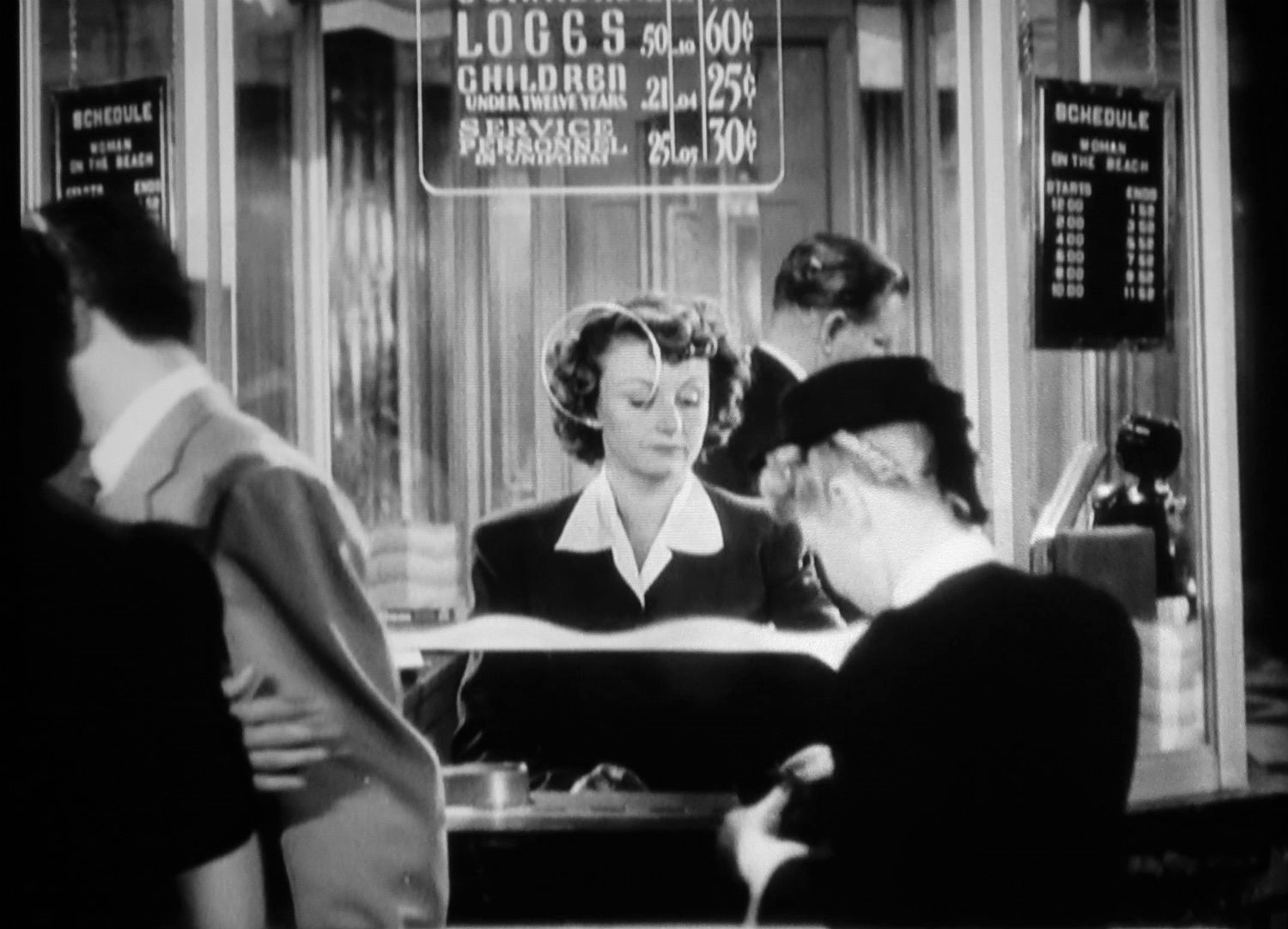
Bari is one of the charming suspects. She says she went to the Pantages, 6233 Hollywood Blvd., the night of the murder so Raft goes to check out her alibi. On the marquee (although looking intentionally blurred in the shot) are Joan Fontaine in "From This Day Forward" (RKO, 1946) and "Man Alive" (RKO, 1945) with Pat OBrien, Adolfe Menjou and Ellen Drew.

Thanks to Jack Tillmany for noting the appearance of the Pantages in the film. He comments: "The exterior shot of the Pantages shows RKO's 'From This Day Forward,' which indeed was being shown there in June 1946 when 'Nocturne' was filmed. However, in the close-up at the box-office, RKO's 'Woman on the Beach' is on the time schedule; the latter film was in production at the same time as 'Nocturne,' but, due to unforeseen production delays, did not open at the Pantages until over a year later, in July 1947. In the ticket lobby we see a poster for 'Riff-Raff' (1947)."


A boxoffice view with, as Jack notes, showtimes listed for RKO's "Woman on the Beach."


Raft having a chat with the manager to see if Bari's claim holds up that she used a $50 bill the night she was there. A poster for RKO's "Riff-Raff" (1947) with George O'Brien is behind the manager. We get a quick glimpse as he moves during the fade to the next shot. 

RKO would take over the Pantages operation in 1949. For a history of the theatre along with hundreds of photos see the Pantages Theatre pages on the Los Angeles Theatres site.

The film also gets out on the streets of Hollywood for some other nice views near Hollywood and Vine including shots of the Brown Derby. Shots from the film appear in Thom Andersen's "Los Angeles Plays Itself" (2003)


A poster appearing on IMDb. 

On IMDb: "Nocturne"

Thursday, February 21, 2019

"Idle Wives"


We pay a visit to the Hollywood Theatre, 6764 Hollywood Blvd., in "Idle Wives" (Universal, 1916). Thanks to famed silent film detective John Bengtson for investigating the film and providing the screenshots seen here. Lois Weber directed herself  in the film. Other performers include Phillips Smalley, Mary MacLaren and Edward Hearn.


We get many shots of the exterior of the Hollywood Theatre as various characters in the film make their entrance. They're from different economic classes and have a variety of problems yet all decide going to the movies is better than staying home. John calls our attention to the name of the theatre in the mosaic tile seen at the entrance in this shot.

Only the first 29 minutes survive of what once was a seven reel film. Long believed entirely lost, what we have was discovered in the collection of the New Zealand Film Archives. It's online from the National Film Preservation Foundation. They comment:

"Characters in the film attend a movie titled 'Life’s Mirror' (pointedly directed by one 'Lois Weber'), where they see parallel, cautionary versions of their own lives. A shop girl 'stepping out' with her boyfriend watches her screen surrogate conceive a child and retire to a home for unwed mothers. An estranged married couple watches as the wife’s onscreen counterpart, played by Weber herself, leaves an uncaring husband to return to her post as a settlement worker. A working family struggling to make ends meet learn the perils of living beyond their means. In each case the recognition of oneself onscreen proves revelatory—film viewing provides opportunities for identification and affect unavailable elsewhere."


A wider view of the entrance. 


The marble boxoffice. John notes: "It’s the same theatre and year where Harold Lloyd filmed 'Luke's Movie Muddle.' The prices and lettering on the box office are the same." He has the Hollywood as #19 on his "Hollywood's Silent Echos: A Tour of Silent-era Hollywood Film Locations." It was assembled as a bonus following a talk he gave at the 2013 TCM Festival.

While the exterior shots for this film and the Harold Lloyd film both used the Hollywood Theatre, "Luke's" shows us quite a different interior. It's unknown where that one was staged. See the post on "Luke's Movie Muddle" for shots from that film.


Another boxoffice view. 


Perusing the displays on the east side of the entrance. 


A fine view of the theatre's house right wall and the loge section. The areas of the theatre we see here actually appear as a pan shot in the film. Thanks to a bit of magic by John we get this CinemaScope version. 


 Getting shown to a seat by an usher.


A group coming in for the cheaper seats. 


The theatre's act curtain. John notes that the businesses we see advertised are local Hollywood concerns. He adds that the image in the center of the curtain is of the Ponte Sant'Angelo in Rome.


The house lights dim as the curtain rises revealing the screen. 

Thanks, John! Check on his latest explorations via the Silent Locations blog "Chaplin-Keaton-Lloyd film locations (and more)." He notes that the movie is included in the Blu-ray set "Pioneers: First Women Filmmakers" from Kino-Lorber.

John's books are available through Amazon or your local bookseller.

"Silent Echoes: Discovering Early Hollywood Through the Films of Buster Keaton"

"Silent Traces: Discovering Early Hollywood Through the Films of Charlie Chaplin"

"Silent Visions: Discovering Early Hollywood and New York Through the Films of Harold Lloyd"

See the page about the Hollywood Theatre on the Los Angeles Theatres site for many photos of the building. It opened in 1913 and is now a Guinness Book of Records museum.

On IMDb: "Idle Wives"